

This is an introductory post about designing and building an AI-powered application for learning Ancient Greek. Our goal is to build a real application, not a toy app or prototype. Our broader objective is this:
We want to learn some crucial techniques for incorporating AI into learning applications.
The choice of Ancient Greek, therefore, is somewhat arbitrary: for one, it’s where my head is these days; for another, the humanities are given short shrift — one might say at our peril.
First, what do I mean by building an AI application? When we think of AI in education, what usually comes to mind are AI tutors, which almost always take the form of a chatbot. I am deeply skeptical of AI tutors — especially if they are intended to replace human instructors — for both theoretical and practical reasons. But I am not going to go into that here.
I will be using AI in two senses. The first is using AI tools (also called agentic AI tools) to build software. There’s a lot of hype around AI, but the one indisputable fact is that it has revolutionized software development. We want to take full advantage of this revolution. So, in the first sense, AI is a tool for building software. The second sense is incorporating or embedding AI elements in software. Another certainty about AI, whether we like it or not, is that all software going forward will incorporate AI elements. Even if we don’t become builders ourselves, we need to understand how AI in software works—its capabilities as well as its limitations.
In summary, we will build AI software using agentic AI tools. In our case, the software will be for learning Ancient Greek.
Pedagogy-First Design
When designing learning applications, I think it’s good practice to start with pedagogy, not technology. When confronted with a learning application, the first question I always ask is: What is the underlying pedagogy? If there is no clear answer, I am not interested. Sometimes we need to be snobs.
In designing our Learning Basic Ancient Greek application, we will take as our starting point the textbook Reading Greek (RG), published by Cambridge University Press. The application will be designed as a supplement to the textbook, not as a replacement. Therefore, we are inheriting the learning design and pedagogical assumptions of Reading Greek.
(Note: RG is copyrighted. I will be developing the application for my own use, but in a general form that could become a multi-user production application. I intend to contact the copyright owners to make sure I am not violating anything.)
What is RG, and what is its pedagogical model? “Reading Greek is a language course written for beginners in the upper classes of schools, at university, and in adult education. Its aim is to enable students to read Attic Greek, Homer and Herodotus with some fluency and intelligence in one to two years.” As I understand it, RG is used primarily in the UK, but it also has a loyal following around the world.
RG was developed by the Joint Association of Classical Teachers (JACT) in 1978. It has undergone numerous improvements, informed by the teaching practice of the best scholars and teachers in the field. It is the ongoing work of a community of scholars.
There are two primary books. Reading Greek: Text and Vocabulary contains a narrative adapted entirely from ancient authors in order to encourage students to develop their reading skills rapidly.
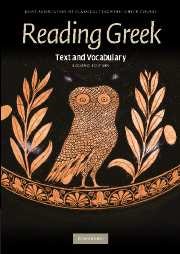
Reading Greek: Grammar and Exercises is the accompanying text and contains full grammatical support and exercises. A third book, An Independent Study Guide, is intended to help students who are learning Greek on their own, with limited or no access to a teacher.
The pedagogical design, or method, of Reading Greek is as follows:
Stage One: Read and translate a passage with the help of a running vocabulary.
Stage Two: Master the learning vocabulary (a subset of the running vocabulary).
Stage Three: Turn to and study the running grammar.
Stage Four: Complete the exercises to reinforce the grammar.
Stage Five: Take the unseen test exercise to assess knowledge gained.
Of course, this is not the only approach to learning Ancient Greek. Way back in the Stone Age, when I was in graduate school, I took a seven-week summer intensive course. The bulk of the time was spent on grammar. We “began” to read only during the final week. The result? My mind was stuffed with grammar and not much else. I also quickly forgot everything and lost all interest in the language.
It’s time to make a come back. The JACT approach seems to make more sense: Get the student to start reading and translating as soon as possible while concurrently acquiring vocabulary and grammar.
In my next post, I will sketch the top-level learning design for the application. This includes incorporating some known-knowns from learning science.